Wednesday, December 23, 2009

CoExistance--A Life Equalizer


"To live together without hostility or conflict."

The goal of peacemaking is a world where we can live--exist--together. As we come to the end of 2009, a time of real spiritual insights, it is time to make the commitment to the idea that this world is built for all of us. Can we? Are we ready to? I personally think we have no choice. But, there are a few points I'd like to establish first.
You can't coexist without engaging. I am always out of my comfort zone except when I am with family and friends. The reason is that family and friends know me. I know them. It is not perfect, by any means, but the comfort lies in our love. We learn in our many religious traditions to love one another. But, many of our traditions also ask us to love our enemies. I believe that enemies are those we don't find comfort in. And that one should try to make enemies into friends--into the comfort zones of our lives. That takes engagement. Until we learn to engage, we have such an uneasy peace and uneasy peace can lead to the hostility that hampers coexistence.
Coexistence is not simply tolerance. Just the other day, someone said to me that he tolerated the way in which I took notes of our meetings. I knew the minute I heard the words that I was being insulted. I felt patronized. I felt that the uneasy peace that goes with not talking through the problems. It is similar to a blog I wrote about agreeing to disagree. That doesn't work for me and I guess it never will. I believe that tolerance leaves a void that says "we are not engaged" and I definitely believe that I don't want to agree to disagree, I'd rather agree to try and understand.
To coexist means "living" ... and to live means to embrace life. When we coexist we are truly embracing all that life has to offer. The strengths inherent in our diversity is what life is all about. If someone says, "I don't see color," I'm suspicious of that person who, I believe, wants the uneasy peace rather than the hard-earned peace. Uneasy peace, which can fracture at any moment, is not the goal of coexistence. Rather it thwarts our ability to coexist.
When I was a little girl, my mother would leave for work after kissing me with her frosty lips of red, marking my lips with a little color, too. I would send her off with a "See you later, alligator." To my delight that still makes me smile, she would respond, "After while, chocolate child." Can you imagine not recognizing the colors of roses--yellow, white, red? Would you fail to notice the color of the sky during a sunrise or sunset? I live for the creative paintbrush of God who made us all so different. God's gift to us is in each of us and it is marvelous in God's sight. It should be in ours, too. After all, God does love the whole world and I'm convinced that it is without any exceptions.
Peace.

Friday, December 18, 2009

Recommitting to the Principles of the Decade


The Peace Hour was created to tell the stories of peace in action and over the last five years has done that. Now we at The Peace Hour are looking beyond the Decade and have decided that our commitment will continue to be to the children of the world and that we will do it in various formats, including making our show available through internet. The last five years have shown us that our work with children is the most exciting work that we have ever done and will ever do. We will continue to bring the stories of peace in action to you with interviews from and about peacemakers. Along with our Peace Hour blog, our website will give you up-to-the-hour information about what is going on in the world. In addition, we are revamping our Sister II Sister blog and have started a wonderful new conversational blog called Wacky Peacemaking. We are bringing innovative ideas and conversations in every format that we can. In the meantime, though, we want you to remember what the principles are that started this Decade initiative and what the future may hold for us as we look BEYOND THE DECADE OF NONVIOLENCE!


Respect for All Life means to respect the life and dignity
of each human being without discrimination or prejudice.

It is funny that respecting life leads the list of principles because when you respect all life, no other principle is needed. In Sunday school I learned Thou shall not kill! and I believed that was a good commandment. Now, I realize that the other commandments are all about what not to do to anyone you might consider unworthy or dispensable. Clearly, you can create tons of commandments that work for the community that is honored and respected, but those same commandments are thrown out the window for the "other." Respect for all human life and dignity for each human being means everybody!


To reject violence is to practice active non-violence in all of its forms.

We think that only physical violence is true violence. Nothing can be further from the truth. While there is physical and sexual violence, there is also psychological, economic and social violence. This violence is usually perpetrated by the powerful against the less powerful, mostly the most deprived and vulnerable communities of the poor, children and adolescents, women and elders. If we think that we are exempt from being perpetrators because we didn't actually commit such atrocities, we fail to realize just how our silence and apathy play a part in colluding with those who do.
     In order to reject violence, each individual must be willing to stand against the tyranny that plagues our planet. We must learn to cease our collusion with the illnesses of society and find ways in which we can stop cycles of abuse that happen all over the world.


Defend freedom of expression and cultural diversity, giving
preference always to dialogue and listening.

Recently I had the opportunity to talk about the importance of words, the impact of what we say and don't say, and how we can better listen. Dialogue and listening should be done without engaging in fanaticism, defamation and the rejection of others. Still, we may not realize how much our words and actions do just that. Again, as discussed above, silence often speaks volumes as does apathy. Our expressions manifest themselves in a variety of ways, so when you're thinking about engaging in dialogue, remember that there is more than one way to say something. Think on it!


Sharing your time and material resources in a spirit of generosity.

Our inability to be inclusive, to understand when our patterns are associated with exclusion, injustice and political and economic depression, has been the bane of our society. Chief Seattle said it best. Earth does not belong to us; we belong to the Earth. Such poignancy from someone who many might have considered conquered should humble us. Instead, we have become people of ownership, taking as much as we can without regard to others. We believe in wealth and therefore, wealth for the few and the privilege. This is not about socialism. This is about community. When we share our resources, the value from that increases significantly and the world is better for it.


Responsible and Developmental practices that respect all forms of life.

No longer a simple admonishment to mankind, preserving the planet is going to take forethought and much work. We have already destroyed much of what is precious about the earth. But it doesn't have to continue. It is clear that we must promote consumer behavior. I learned recently that a woman only generates less than 5 pounds of trash a month. Unheard of. In fact, it may well be true wacky peacemaking at its best. In America we generate tons of trash. Imagine consciously choosing to create less trash. Using cloth napkins. No styrofoam or plastic forks. Time consuming, but ain't our planet worth it?


or "Rediscovering Our Solidarity"

What are ways in which we can contribute to the development of our communities? And as I've asked over time, "Where is our community?" A simple question with complex answers. If we think of communities as places where people look and act like us, that's one thing. When we think of the world as a variety of communities where we all can take a part, that's profound. Traveling has afforded me the opportunities of being part of communities around the world--women, people of color, yes, but peacemakers! I am discovering that solidarity with those who believe in building cultures of peace are so wonderfully diverse that we are solving most of our problems with these simple collaborations. But, there's another aspect of contributing to our communities that is essential. There must be full participation of everyone and that includes women and it includes respecting democratic principles so that we can formulate the most positive aspects of solidarity possible.
     So, there you have it!
     Are you ready to rededicate yourself to the principles of the Decade and beyond? Let's get to work.
     Peace! 

Tuesday, December 08, 2009

IN FOUR DAYS ...

Join members and endorsers of The Decade of Nonviolence for an evening of peacemaking through fellowship and fun. Fellowship and Fun do go together. We'll laugh and smile as we share our work and our aspirations of building cultures of peace. There will also be an auction to raise money for Decade Programs in 2010. Some auction items come from a place that epitomizes peace ---

http://www.tenthousandvillages.com/

Ten Thousand Villages works with over 130 artisan groups in more than 38 countries in Africa, Asia, and Latin American to bring you fair trade jewelry, home decor, gifts and more. They are one of the world's oldest and largest fair trade organizations in the world. Ten Thousand Villages provides the opportunity for a better quality of life.

The Decade Principles are Respecting Life, Rejecting Violence, Sharing with Others, Listening to Understand, Preserving the Planet and Contributing to Our Communities. We share these stories on The Peace Hour. Look for The Peace Hour to resume soon. More information to follow or if you want first-hand information, come to the Decade Event at The Houston Mennonite Church, 1231 Wirt Road (North of I-10), from 5 p.m. to 9 p.m., Saturday, December 12th. We're looking to see you there.

Peace.

Monday, December 07, 2009

Fantastic Authors and Artists ...

THREE FANTASTIC BOOKS FOR THE DECADE

The Decade of Nonviolence has six principles that urge all of the world's citizens to embrace. All six of these principles are encompassed in three books: Within These Walls: Memoirs of a Death House Chaplain by Rev. Carroll Picket, Detour to Death Row by Houston's own Dave Atwood, and The Challenge for Africa by Nobel Peace Laureate, Wangari Maatha. The principles that these books urge us to look at concern human life and the Earth. Anti-death proponents, Rev. Pickett and Dave Atwood, believe in the sanctity of all life. They recount their experiences about the death penalty and its ill-advised use to combat crime, but also as a bad use of the penal system. The principles of the Decade they employ are "Respecting life," "Rejecting violence," and "Listening to Understand." Nobel Peace Laureate Wangari Maathi employs the use of the other three principles in her book "The Challenge for Africa" of "Sharing With Others," "Preserving the Planet," and "Contributing to Our Communities." She offers up her work "in the trenches with others to find ways to break the wall that separate the peoples of Africa from justice, wealth, peace and respect." All three books will be auctioned off on December 12, 2009 at the Houston Mennonite Church, 1231 Wirt Road (North of I-10) at the Decade Event. Each book is signed by the authors. For more information contact either Judith Hoffhein at 713-863-8708 or P.K. McCary at 713-893-1304. You can offer a bid for any or all of the books by emailing us at info@thepeacehour.org. Please note which book or books and your auction bid.

REMEMBER, PEACE IS AN ART FORM

Remember that you can also bid on fantastic art at this Decade event. Houston artist Chuck Ivy offers as an auction item "Wife/Lover," a 20x30 print facemounted on plexiglass. Chuck Ivy is another Houston artists who work can grace your home. Bids for art pieces start around $100 and are for a good cause to support the work of the Decade's work in 2010.

Again, for more information, contact Judith Hoffhein at 713-863-8708 or P.K. McCary at 713-893-1304. Each piece will be at the event on December 12, 2009. You can also email us at info@thepeacehour.org.

Saturday, December 05, 2009

Hug A Bear of Your Very Own


Ever wonder about the story behind "Teddy's Bears?" More than just cuddly, teddy bears have a history. As everyone knows, real bears disappear in winter and reappear in spring. Bears symbolize renewal and rebirth. In some cultures, the bear symbolizes female energy and is considered powerful medicine. But, the story of the teddy bear did not come about because of her symbolism. Instead, the teddy bear was borne out of a story about President Theodore “Teddy” Roosevelt’s refusal to shoot a bear that had been captured. He considered it bad form and lacking ethics. A Washington Post cartoon by Clifford Berryman captured the story, which was seen by a Russian immigrant by the name of Morris Michtom who asked his wife, Rose, to create a stuffed bear like the one in the cartoon. She made one and put it in the couple’s store window and it not only sold, but every bear she made sold out, too. The bears were dubbed “Teddy’s Bears” and were a huge success. President Roosevelt gave his permission to continue calling the bears by his nickname “Teddy” and the rest is history. The Company’s name was the Ideal Novelty and Toy Company, which still exists today. This story resonates with us here at The Peace Hour as well as on our Think Peace Radio Network, but in addition so do the symbols associated with the bear. We find the idea of bear magic appealing. We love the idea of renewal and rebirth since both are needed for each of us committed to the peace movement. Because of the bear’s fierceness and strength, we believe that bears also symbolize our need to utilize our combined strengths as passions to build cultures of peace all around the world. In addition, we believe that the symbol of the bear is perfect for the work that we do, telling the stories of peace in action.
     Our bears come with t-shirts that say "God Bless the Whole World, No Exceptions," Think Peace," and our new t-shirt with "Give Peas a Chance." We've included a picture here for you. 


"Won't you take one of us home?" Bears are available for your support of The Peace Hour and Think Peace Radio Network. If you're interested in having one of these bears for your very own, email me at info@thepeacehour.org for pricing information.

You're Invited to A Decade of Nonviolence Event ...


You're Invited to a evening of Fellowship and Sharing ...

When:
December 12, 2009

Where:
The Houston Mennonite Church
1231 Wirt Road (North of I-10)

Time:
5 p.m. to 9 p.m.

The Decade of Nonviolence-Houston invites you to a holiday event at the Houston Mennonite Church, 1231 Wirt Road (North of I-10) so that we can share food, fun and fellowship to talk about Beyond the Decade: Where do we go from  here? The Decade of Nonviolence is a movement. Regardless of the wars and rumors of war that float throughout the world, peacemakers ARE making an effort and we are also making a DENT in the violent aspects of our lives. Come learn about Compassionate Communication, Peace Camp, Peace Education in Schools, and yes, The Peace Hour. Our work is really only just beginning.

ATTENTION: If you're an organization or group who endorses the Decade, please contact us so that we can list you in the program. In addition, bring your materials and information. We'll have a place set up just for you! We will be holding an auction to help raise money for the future of The Decade. Remember: Peace is an Art Form and we'll bring the creativity of peacemakers to you on this night, from 5 to 9. For more information, email us at info@thepeacehour.org or call P.K. McCary at 713-893-1304 or Judith Hoffhein at 713-863-8708.


AUCTION --- Peace is an Art Form

"Alien Friend" by Jennifer Chen


Kane Pau "Water Blossom" Lee
by Bobbie Jo Free

Artists from Texas and California have either donated or given at costs works that make a difference. Artists include Jennifer Chen a.k.a. "Komodokat," Burford Evans, Bobbi Jo Free, and other artists who showcase their works at the Black Heritage Gallery in Houston, Texas. Also, auction items are from 10,000 Villages and donations from private donors and collectors.

Proceeds from this event will benefit the Decade of Nonviolence--Houston, a non-profit charitable organization, and its programs: Compassional Communication, Peace Education in Schools, Peace Camp and The Peace Hour and Think Peace Radio.

BEYOND THE DECADE ...

The Peace Hour broadcast, as many of you know, is an initiative of the Decade of Nonviolence, when living Nobel Peace Laureates made their appeal to the world that we use this first decade to build cultures of peace for the children of the world. These last five years, I have started every show with these words. Next I say, "Many have heeded the call." And now I ask, "have they?"
The Call to Peace
As we head into 2010, there are many who feel that we've failed or at least are failing at building those cultures of peace in every day life. In America, we are struggling through a horrendous recession. We can't agree on ways to ensure that every American has health care or access to good health care. We fight over whether to stay in wars on the other side of the world--Iraq and Afghanistan, for instance--or whether to bother with conflicts in areas we don't think are important enough to warrant our time or efforts. The Republican/Democrat wars are legend. The wars around the world, many conflicts ongoing, don't seem to be abating. Every day, there is some conflict that results in the deaths and maiming of others. The Uppsala Conflict Data Program tells us that armed conflicts around the world result in 1,000 deaths a day! If we take a look at the world, we'll see that there is a conflict going on in almost every part of the world.

While this these violent conflicts include major and minor conflicts, they also include non-state and one-sided violence (UCDP Database, 2009). Still, this doesn't include the violence inflicted in homes, cities, states and nations, in families, in business, and in our "Peace" organizations.
     If I had to establish what hurts the most, I would say that the violence that hurts the most is violence perpetrated by those who are supposed to care and those who should know better. For the models of peace are there for us to use when conflict arises, but somehow, we don't always use them or maybe we haven't really learned how. When people that we love, respect and care about, resort to violence, our lives are shattered by that betrayal. When people fail to see that violence can happen without the use of a fist or a gun, that the weapons of hate, deceit, disinterest, disenfranchisement, disrespect and other types of actions more subtle, are as devastating to the soul, we'll never get this peace thing right. Weapons such as these can kill the spirit, the will and the heart of a people. It can make us jaded, cynical, but it can also make us afraid. Afraid to speak up. Afraid to venture forth. Afraid to use our gifts and talents for the good of humankind!
     Still, this is my heart talking. My brain tells me to look beyond the shadows. As one friend told me "Never attribute to malice what incompetence is sufficient to explain." Peacemaking is a lifelong endeavor. We have to get "good at it" in ways that make accomplishing it something like breathing. In. Out. Deep breaths. Exhale. My Yoga friends would agree.
   Another thought from this friend talked about the complications embedded in this world of peacemaking. He described them as "so many interlocking and overlapping, yet often competing, responsibilities" that we often drop the ball far more often than we admit. We too often focus on the one event that has been difficult rather than looking at the entire picture of events. My friend went on to explain it this way, "I DO think that [people] are often myopic and short-sighted (and redundant). There is a constant tendency to focus on the matter or issue or crisis that is right in front of a person and forget that decisions about the immediate matter affect other previous commitments, or even contradict stated principles and goals." In this, I found an answer that I think we must truly evaluate in ourselves. Am I so myopic or short-sighted that I'm concentrating on the immediate goal or problem? Do I only think of what is solved right now, rather than all the layers that it affects? I have to ask this question of myself because unless I reflect and evaluate my own purpose, I have no right to demand it from others.
The Vision
When a person is hurt, compassionate communication urges us to "listen to the need of that person" and that by understanding that need, acknowledging that need, we then are able to empathize. Empathy connects us. That's the "heart" part of peacemaking. We all need to listen to our hearts a little more.
     Besides the complications, we have systems that have been in place for centuries and these systems create disparities that resonate in different ways. We cannot create cultures of peace within these systems. It's a given that these systems must change. And here lies another problem. In order to change systems, many feel that we must use the same methods of these systems to vanquish that which we considered unholy, unhealthy or undesirable. This is defined as a takeover and takeovers are simply, to coin a violent analogy, simply "the faster gun." Instead, we must throw away these weapons and create models that mirror the best of our methods. Charles Edwin Markham talks about this when he says, "They drew a circle that shut me out--heretic, rebel, a thing to flout. But love and I had the wit to win; we drew a circle that took them in."
Who's In/Who's Out
I'm out! I took myself out of a situation for reasons that I won't go into. It isn't important. What is important is that it hurt. I don't do hurt well, mostly because I try to anticipate hurt ahead of time. I walk around with my hurt detector on, but it is not infallible. So, then I'm surprised (well, not really), or taken off guard, then I start second guessing myself and trying to deal with the current issues (or what is perceived as the current issues) and I'm trying to fix those and I am, as my friend so appropriately points out, "myopic and short-sighted." I start trying to change the system and it isn't my place to change anything. There are a number of reasons why this is true. The biggest reason is that I have not nor will I have power in these systems. These are systems that I cannot take over even if I wanted to. I don't belong and it gets harder and harder to participate in a system where I am not only uncomfortable, but also have no real say. The most significant reason I can't change these systems is that I-can-only-change-myself. We must, after all, be the change we wish to see. When we do that, I can leave a little residue of my intent to empathize and love the people within these systems and perhaps those in power or control can use that, when and if they choose. But it is not now nor was it ever my job to change another. And even if someone tries to say that it is, I decline the offer. Thanks, but no thanks.
     Instead ...
     I want to build an place that is the wider circle built on principles of the Decade, but also principles of my faith, a place that still holds hope and love for the world. I want to build a place where the energy of young people is harnessed and developed, giving their creativity, gifts and talents free reign in the world. I want to capture the wisdom of the elders. I want an organization that supports intergenerational relationships. As a storyteller, I want to gather the stories and share them with the world--my way of sharing the world's cultures with one another. I want to be free--free to be all that I can be and along the way, stop to make sweet potato pies for my family and friends. In essence, I want to live this life to the fullest as a peacemaker. That's the job I'm applying for every day of my life.
     Someone said that if you build it--they will come. So, you may ask--why do I think I can build it? That's easy! Because everyone has it in them to do it. Because--after all--I'm In! In this world to do good.
     Peace.

[The Peace Hour broadcast will be heard every week on the Think Peace Radio Network, on OhZone.org, with archives at www.thepeacehour.org starting December 7, 2009. For more information on the work of The Peace Hour and the Think Peace Media and Communications Cooperation Circle, email us at office@thinkpeaceradio.net. We're building it. Won't you come?]

Friday, August 08, 2008

WITH THESE SIMPLE WORDS ...

WE CAN START HEALING THE HURTS OF THE WORLD


"Two Sides of the Coin--An Apology, Forgiviness"
The Price of Reconciliation and Healing


The incident happened years before. I had been fired from my job unfairly. It was a job I loved and it loved me, too. I had found my calling and then in a matter of minutes, with only a few words, it was gone and there was nothing I could do to get it back. I was hurt and disillusioned. As I attempted to overcome it, I was often given this advice: “Let it go. Just get over it” and I strived to do that. It took me a while, but over time I “got over it.” I worked at it. I didn’t talk about it much. Sometimes something would trigger a memory or a friend would ask about it. Truthfully, I didn’t recognize it as hurt anymore.

Then one day I had lunch with someone who wasn’t there those many years ago, but who now worked for this same organization. Yes, she’d heard the rumors about some of what had transpired, stories that still lived on. But, here’s the crux of the story. As we left lunch and I offered my help and support to her, to an organization that had “hurt” me but that I had a special bond with, this woman said, “I’m sorry for what happened. You’re a remarkable person and I’m glad to know you.”

I’m sorry.

This individual took responsibility for a slight, a hurt, a pain that I thought I had overcome and with those simple words, relief flooded through me. I almost responded, “Why are you apologizing? You didn’t have anything to do with it,” but I stopped myself and said, “Thank you. I accept. I appreciate the sentiment.” And now, the healing has begun. Where I thought I had merely “gotten over it,” now I am finally free.

A long time ago I wrote an article about forgiveness. I told my readers that forgiveness is a balm for most of the world’s ills. In fact, I believe that forgiveness is so important to our world’s health, that we must take it upon ourselves to offer it again and again. The truth is, though, that it takes lots and lots of practice; that it doesn’t come easy, but oh—it is worth it. And yet, what I’m learning is that forgiveness is only one side of the coin. The other side is repentance. Repentance is the “I’m sorry” that comes from genuine remorse and a desire to make it better. Together the “I’m sorry” and “I forgive you” are the coin that paves the way to reconciliation and healing.

But what of the “I’m sorry”? Many of the ills of the world were created by people who are no longer here. Yet, the tragedies of the world still permeate our air space and if no one is willing to offer the first half of the coin, how are we to spend only one-half of a coin? Forgiveness can be given without an apology, but it is not as potent. Without the full coin, you still have an incomplete, unresolved issue. In the story above, one person held the side of the coin that merged the part I had already given. I still believe that it was my responsibility to forgive, but having someone stand for the apology finished it—healed the rift. I’m now whole.

There are many other stories. At a prayer vigil for the earth in Washington, DC, a friend who is a minister offered an apology for what had been done to thousands of our Native brothers and sisters. He took responsibility for making the apology at a ceremony of healing because without it, there was a void that could never be bridged. He understood that the pain caused from broken treaties, displacement, and atrocities too horrible to mention, stood in the midst, ghost-like, but palpable to the soul of a people. He tapped into it through a genuine connection with a people who have offered forgiveness through a charitable spirit of love and compassion.

This wasn’t about guilt as much as it was about acknowledgement of the hurt. If you ask if I want an apology for slavery, I might even say no. After all, I was never a slave. But, truth be told, I’d like an apology for my ancestors, heartfelt and genuine. I want to know that my grandmother’s mother and father and all the unknowns of my ancestry are finally getting their apology and when it comes, I, who stand on their shoulders, accept the apology on their behalf. As a child of the Diaspora, I, who carry the DNA of those whose blood was spilled, can stand for them today. And, I, can stand for those who have been lynched and died at the hands of those “who know not what they do.” That comes from my Christian faith, but there are so many who are willing to stand in the gap for other tragedies. Hiroshima. Germany. South Africa. There are those who will stand in that gap to close the circle of pain into one of healing. But, who will carry the “I’m sorry”? Who will stand for the hurt and pain in genuine remorse and supplication? Who will stand with me?

I’m willing to stand for the “I’m sorry” side of the coin. I know what it feels like on the other side of it, but I’m genuinely sorry for the ills that have happened by my country’s hands, for the abusers of children, with true regret for the pain caused to them. I’m willing to bow my head, lower myself to my knees and stand for the “I’m sorry” that so many need. Can you? Will you join me?

As I’ve listened to other stories of pain on this show and in my travels, I’ve been shown the power of it all. I know it can happen and I have the perfect occasion to start—a day that each of us can take a role—either for the apology or the forgiveness. The spirit of it defies the gravity of any situation, no matter the hurt, no matter the pain. The spirit of it is to move forward to the reconciliation and healing of the world that needs to take place. If in this small ceremony of giving and receiving I believe that lives can change, so can each of you.

The International Day of Peace is September 21, 2008. I’m asking that we meet at churches, at synagogues, at temples, at parks, in homes, on the street—and stand for the apology and the forgiveness. Two people can do it. Thirty people can do it. A thousand people can do it as well. With half standing for the “I’m Sorry!” and the other half standing with “You’re Forgiven,” the work begins. We’ve gotten the hard part out of the way. Then, afterwards, we should start working together in our families, communities, and organizations, to reconcile and heal. The efforts of this one simple ceremony can reverberate around the world as we stand in the gap for all who have gone before us and all the good that can now come.

I’m sending out a request to all my relationships across the board—The Rothko, Interfaith Ministries, my church, my friends, my family. I’m asking that we take a place—either in the circle of Apology or the Circle of Forgiveness. You can carry signs that say “I’m sorry for Hiroshima,” or “I’m sorry for abusing a child,” or “I’m sorry for not ending Apartheid sooner (in any place that it is taking place)” --- and I want someone or many to go and accept that apology. Today, I give my forgiveness for the millions of children without healthcare. That’s a for instance, but it doesn’t stop there. Now the work begins. No one has to feel guilty because the full coin will let us purchase time, efforts, commitment—working together. That’s you and me.

So, you can call me at 713-893-1304 and tell me you want to participate. I’ll help you do it. You can email me at info@thepeacehour.org. I’ll respond back. Here at KPFT, the Decade of Nonviolence, in my work with United Religions Initiative and the World Peace Prayer Society, the many places we talk about building a better world, let’s hold the powerful synergy of the Apology and Forgiveness and start the reconciliation and healing process that eludes us. Today.

May Peace Prevail on Earth.

Tuesday, September 26, 2006

The Peace Hour.org

The Peace Hour.org

9/11 Mysteries (Full Length, High Quality)

All voices must be heard. Whether we agree or disagree, without full disclosure, without listening to all sides, we will never know the truth. This documentary of the 9/11 historical even brings to light QUESTIONS. This domain 9/11 Truth documentary portends that there is more to come. An excellent document. Pass it on.

Thursday, September 21, 2006

International Day of Peace--A Day of Prayer

PRAYER CHANGES THINGS


"When children pray, God listens. Are we listening?"

On this International Day of Peace I am reminded that we live in one world. Today, many of our world’s citizens are celebrating this one day with the hope of peace eternal. Peace is a concept for the mind, body and spirit. I’m especially grateful that these next few weeks are also symbolic of peace. We celebrate the Jewish New Year and Ramadan. This is a poignant reminder that we CAN walk side by side.

Someone asked that we celebrate this day with prayers, poems and songs. My prayer:

Wake in me, O Lord, the need for another
Prepare in me, O Lord, the way to acceptance
Instill in me, O Lord, true love and compassion

Help me, O Lord, to accept your gifts
And then, O Lord, let me live in thanksgiving for the harmony of this world.

Amen

My Poem:

I look on the faces of my sisters and brothers
To see the desires and dreams in their eyes
I look at the hands of my sisters and brothers
To clasp in fervent prayer for one another

I see beyond the different hues,
The cultural resonance of voices of different lands,
The shapes of eyes, mouths and noses,
And I see the Wisdom that God demands

I listen to the prayers of all
In languages too numerous to count
Chants, songs and silent meditations
Become a symphony of hope for us all

I see each of you
I see God

And my song:

Let us break bread together on our knees
When I fall on my knees,
With my face to the rising sun,
O Lord, Have mercy on me

Let us clasp hands together on our knees
When I fall on my knees,
With my face to the rising sun,
O Lord, Have mercy on me

Let us sing songs together on our knees
When I fall on my knees,
With my face to the rising sun,
O Lord, Have mercy on me

Let us praise God together on our knees
When I fall on my knees,
With my face to the rising sun,
O Lord, Have mercy on me

And my final prayer:
Lord, have mercy on all of us. On this International Day of Peace, let us remember that we are each in need of your mercy and love. That we are in need of your compassion and grace and that in giving it to us, we will return the favor by giving it to others.

A blessed and hopeful International Day of Peace. P.K.

Sunday, July 02, 2006

Faith and Peace—The Only Way


I spent time with my grandson this week. As he knows I usually have something for him in my room, he went in to see and when he came out, he had my prayer beads looped around his neck. I told him about the beads and knew he understood as much as a two-year can, because the rest of the evening, he told everyone he had "Buddha Beads" around his neck.

I am a peacebuilder. I think I was born to be one. At age twelve I finally made six feet in height. My father took this opportunity to explain to me about the responsibilities of being tall. I would imagine he would have had to be the one. He was six feet five inches tall himself.

“P.K., do you know how tall you are now?”

“No, Daddy,” I responded. “I just know that I’m taller than most everybody in my class except a few of the boys in the 11th and 12th grades.”

I was in the eighth grade then, youngest of my classmates—taller than almost all of them and all of my teachers. My father’s mother had always emphasized standing tall and since that was ingrained I stood tall. That day I learned from my father that I would sometimes seem taller than people the rest of my life and probably would be. I’m 6 feet and 3 inches now. So, my father sat me to down to explain about size and the power size can have. He explained about periphery vision and how it played an active role in people’s perceptions about space. He told me how precious a person’s space can be. He also told me that I had a new responsibility now that I had grown so tall.

This is what he told me.

“People will see you before you see them,” he tells me. He explained that this could be a good thing. “But sometimes people will see you as a hindrance before you’ve opened your mouth.” And then he told me something I never thought about. “You will be perceived to take up a person’s personal space even when you don’t mean to.” My father then stood and demonstrated what he meant. He told me that people consider a certain amount of space their own. “If you tower over them,” he said to me as I looked up at him, “someone may consider that you are taking up their space.” My father’s height was imposing when we both stood. Now standing over me as I sat, I immediately understood his meaning.

“You can continue to tower over them, continue to make them feel uncomfortable or,” he smiled, “you can even the field of vision so that you are no longer threatening.” He demonstrated by sitting down again with me.

I told my father that I would never do anything to threaten another person. I was a gentle giant, after all. He told me that he believed that I would not. However, he gave me this last piece of advice. He then told me that there may be times in my life I need to make a point. His words to me were simple. “It is then that you stand.”

I’m also storyteller—naturalized, of course. My Aunt Ollie, my mother’s sister was the other family griot. I believe I inherited her gift. She was also the oldest of my mother’s siblings as I am. My mother told me when I was quite young that she and her siblings seldom could afford the nickel movies, so they would let Ollie go instead. She would return and tell them the story of Gene Autry’s pursuits and victories in movies such as “Back in the Saddle”—even singing the songs that made him so famous. I’m the oldest as well and I’ve been practicing my storytelling skills on my younger siblings for many years. I believe that my ability to tell a story has helped me to take the advice my father gave and use my skills as a storyteller to simply stand when there is a point to be made. These days the point is—there is no way to peace. Peace is the way.

So now I’ve become a student of peace through non-violence. I say student because I’m still learning. I believe that Jesus was also a teacher of non-violence. I’ve learned that non-violence cannot be simply a concept or even a tool. It must be a way of life. How else could Jesus at the moment they came to arrest him speak to his disciples so passionately for peace after Peter cut off the soldier’s ear. He said to them, “There will be no more of this!” How was he able to do this? Because he had prepared for it his entire life, at the moment of whether to use violence or non-violence, he had no choice. He chose peace. He even healed the person who came with a sword with the peace of healing. I’m sure that soldier was never the same. Perhaps at that moment, he lay down his sword. Even then the tenants of non-violence spoke that there is no way to peace—peace is the way.

Personally, I think God made me tall for a reason. He wanted me to be seen. But, God also had a plan. He never wanted me to use my size to bully or hurt another. He wanted to show that big doesn’t always mean power, but it can speak truth. As I learn the lessons that Jesus taught; that others such as Gandhi, Lawson and King also taught; I realize that I want no other life. I also know now what my father meant when he said that there would be times when I would have to stand. I stand to convey the stories of peace through my gift and hopefully show the way of peace in every facet of my life—in height and stories.

So, when the time is right, I'll tell my grandson this story. He's going to be tall. That's a fact. But, he will already know that his height is a gift (as it was to all of my children) and that I will hold to non-violence because of him and all the children of the world. He's my Little Buddha, after all.

---Peace

Monday, June 19, 2006

Answering to Who We Are ...


My Dear Children ---

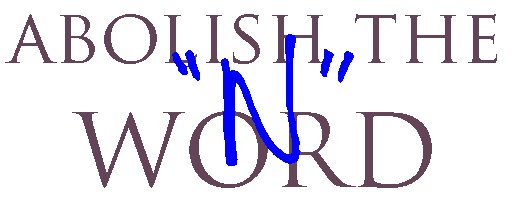
I want to abolish the "N" word. And while we're at it, I want to abolish self-doubt, self-deprecation, self-hatred. That is what the word NIGGER means to mean. I don't care how you spell it, how you say it, it is a word forged and fueled by hate.

I love you. From the darkest ebony to the lightest olive of skin, I see your beauty. It is blinding as it tells both the joy and the sorrow, but also the perserverance of a people who have endured much. And when I see that someone would pay you to say the word over and over again in a rap song, I not only want to protect you from the word, but also from its meaning.

At www.abolishthenword.com, a song plays in the introduction called "Strange Fruit." I remember the first time I drove through the South, heading towards Atlanta. I'd never been much pass the Louisiana border, but as I drove into Alabama, just as the sun was clearing the horizon, I saw lush, green, Kudzu. It choked the trees as it rambled around the trunk of huge trees and wound its way through the branches. The leaves looked rich and strong and I couldn't help but cry savage tears. It broke my heart in two and at that moment, I didn't know why. My babies (they were babies then) slept beside me and in the back and I felt afraid. Yet, I didn't know why. I thought it was hormones or something, but as I tried to look into that lush, green, forest, it came to me. Here is the growth from the soil nurtured by death. MURDER.

I can't begin to help you understand what went through me that morning. I looked again at my babies and knew that I would never let anything happen to them. I resolved, that was then--this is now! And stayed two years in Atlanta before deciding that I couldn't always separate the then from now in that place.

We have come a long way. That much I know. I have three beautiful children, a wonderful, intelligent grandson who is full of energy and life. And I have a new mission---to help end the use of the word, not to be afraid of it, but to never answer to it. Neither from friend or foe.

"Strange Fruit" has been sung by many. My favorite version is still Nina Simon's, in part, I believe because she took herself away, as I did, from the tyranny of the south. Did she find comfort in another land. I doubt it, but she kept her sanity, I believe, because of it. I often look for those sacred spaces---places away from racism and classism. I find it, too. My friends far and near have shown me those sacred spaces, where racism and the other isms of life are conquered. They are conquered by our friendships and other friendships like ours and the knowledge that it isn't just because I'm the exception to the rule (I'm not), but that we find the humanity in each other and relish the love that comes from knowing true relationship despite the differences.

This year I've spent time away from home. I was running away for my sanity, it seems. A lot has happened in the last decade that makes me understand how precious life is. Hard times can make us hard, or ...

And here is what I'm learning. Hard times can make us appreciate the quieter, sacred spaces because there is nothing that guarantees hard times won't come. Just ask those who were displaced by Katrina last year. Ask any child in Uganda and ask anyone who has lost a loved one. But, as to what I'm learning, we must answer to who we are. Who we are is God's gift. Because we are a gift to one another, we should call ourselves by our rightful name. We aren't any of the names that were created to separate us, to make us feel unworthy or unloved, to disenfranchise us. No matter the race or culture. We are God's gift, children of the world, brothers and sisters all. So, the next time you want to call out to your homegirl or boy---remember, brother or sister is who we are and that's all we should answer to.

--- Peace

Thursday, May 04, 2006

Lord, I Want ...

to be a Christian--in my heart!


Yes, I want to be a Christian--in my heart. It is, I believe, where Christianity truly resides. However, I understand that once I am a Christian in my heart, I am now challenged to the be a Christian in my life.

On May 5, 2006, I will have a conversation with UT Professor Robert Jensen and pastor of Austin's St. Andrews Presbyterian Church, Jim Rigby. Both have been caught in the crossfire of two dissenting groups: Christians and Atheists. I haven't had the honor of meeting Rev. Rigby, but I do know Bob. And the truth is that I know quite a few professed atheists and further, I don't like some of them. There! I said it.

So, why do I like Bob, the professed atheist, and not some others? Well, its quite simple. Bob has never made fun of or ridiculed my beliefs. I guess I'm sensitive when it comes to someone telling me that what I believe is about my being both superstitous and stupid. I don't like being made fun of especially when poking fun is done to try to make me feel bad. These days I don't defend my beliefs. Not too much anyway. I'm at least hoping that my actions speak louder than my Christian rhetoric. Of course, as I've learned, I often fall short of this Christian action when my back's against the wall. More often than not, I just don't want anyone trashing my beliefs. I also know that I've got to get over it.

Once, as part of a panel discussion, I responded to a question from the audience where I talked freely about my faith. Soon after, one of the panelists remarked that he wanted everyone to know that he didn't believe in God and that he certainly wasn't a Christian. He said that he was a Marxist and that Marx pointed out that "Christianity is the opium of the people." It got him a few snickers, but when it came time to respond, I told him, "Speaking as my drug of choice ..." 'cuz if that's his definition, I'd roll with it. But, what I also said was that my faith, my belief, wasn't a license to ridicule him just as his Marxism wasn't a license bait or ridicule me.

And I guess that's the reality of where were are. We've got so many divisions, some of them pretty darn serious. Racism. Classism. They each rank right up there as the number one divisiveness. And when I intellectualize things like faith, belief and religion, I find that I'm often not standing for much if I don't take a stand.

It's interesting to note, however, that it is easier to ridicule me about my Christianity than say, Desmond Tutu. Some of the very folks that will do their level best to 'diss' me would break their neck to get a seat next to Bishop Tutu and not because he's a Christian. Simply because he's famous. I've watched it happen too often to mention here, but suffice to say that we're constantly throwing out the baby with the bath water when we put up the fence of division, only to tear it down when it suits our purposes. Anyway, it would be a lot simpler to build bridges for all the building and tearing down that we do. And I'm guessing that we're only going to start building bridges when we find a way, as I'm thinking Bob and Pastor Jim have, to build a bridge where none existed before.

So, what's the answer? Seems like every peace hour blog ends with that question. I wish I had answers -- the kind of answers that would make folks say, "Hey, she's got a point--a good one." Then they'd change their narrow-minded, gilded actions to be more like the heart of Christ, even if they don't believe he's the son of God. I don't mind. I really don't. That's not the sticking point. The sticking point for me is to say you believe it and then act like you don't. And when its all said and done, I just want to know that I'm Christian in thought and deed and that if you're not, you at least act like a decent human being--Christ like after all. Makes us even, sort of.

So, I get Bob's Christian trek and I at least know that when we stand shoulder to shoulder on the same pew, we're talking about the same tenets of faith that makes us want to build a culture of peace for the world. That's bridge building, folks. Amen.

Tuesday, April 25, 2006

The Peace Hour Vision ...


"The future is something which everyone reaches at the rate of sixty minutes an hour, whatever he [or she] does, whoever he [or she] is."
--C.S. Lewis

This quote from C.S. Lewis jumped out at me this morning as I started writing this week's blog about The Peace Hour radio program. The Peace Hour offers its listeners a chance for one hour to explore the reasons for peace through non-violent communication and action. If we are heading into the future, as Lewis acknowledges, at sixty minutes per hour, we might be looking at accomplishing peace in record time. That's the quest and hope of The Peace Hour. As stated in its mission statement, 'The Peace Hour sets aside sixty minutes to explore peace through non-violence in the stories of others.' This is one small step on the road to accomplishing the peace we wish to see by finding those who are that peace in word and deed. What I am finding in doing The Peace Hour is that the voices of peace vary in cultures, races, classes and religions. They are male and female. And they are brothers and sisters of the Earth family--connected by threads. Some threads are delicate and break easily. Other threads are sturdy and durable. Every thread is important, however, to the fabric of life. Woven together, all are strong.

The Nobel Peace Laureates of this time have appealed to us to build a culture of peace for the children of the world. What does that mean? I try to answer that question on each Peace Hour program. When I find evidence of it, I try to capture it in story form. I do my best to set aside my biases and prejudices when telling these stories, but I have found that I AM always a part of the story. We all are. That's another reason for the peace hour. Connecting us one to another is what building a culture of peace is about. If we don't stop to think of ourselves as part of the whole, we will continue the spiral of violence that has permeated the centuries before.

This Decade ends in 2010. What will we have accomplished? I'm not sure. But I am sure about this. We will accomplish more than we could ever believe possible. Why? Because every day someone takes the road to peace at sixty minutes per hour, 24 hours a day, seven days a week, 365 days a year---day in and day out. We are clocking the minutes and so is the peace.


Tuesday, March 21, 2006

Peace Education In Schools

“We’re building a culture of peace for the children of the world.”

Why should peace education be taught in schools? Simple. Because there is no way to peace. Peace is the way. I've waited all my life for a method by which we can teach children honesty, respect and integrity. But, I realize that we teach them that and more. We also teach them to lie, to steal and to turn away from endeavors that take time and effort. We want easy. We want fast. We are teaching our children that "other" children don't matter. It is worse than when we taught that the world was flat. Yet, I'm convinced that while we are teaching bad behavior, we are waking up. And waking up means a constant vigil into self to understand why we don't become the peace we wish to see.

I was with my grandson this weekend. He wanted gum. I said, "Please, may I have some gum?" He looked at me and held his hand out more forcefully. "Gum," he said with a seriousness that meant he wanted it then and there. I said, "Gum, please. You must say please if you want some gum." He cried. He demanded gum as he said with more force, "GUM!" I said, "Unless you say, 'gum please' or 'please may I have some gum,' I will not give you any gum. And I put the gum in my purse. He cried in earnest and I took him in my arms. I held him and started singing a made up song.

Please is a word that says you care
Please is a word that gets you there
If you say 'please' I know you care
And please can take you anywhere

Please, Please, Please
Won't you please say please
If you say please
Then I won't sneeze

And then I pretended to sneeze. He laughed and said with that wonderful smile of his, "Gum?" And I said, "Gum, please." And he just looked and put his head back on my shoulders. He wanted gum. He didn't say 'please' and it seemed we left it there.

The next day as we were getting ready to go outside and play, he asked for a cookie. "A cookie, please." And with a grin so wide, he said triumphantly, "Cookie, PLEASE!" And I told him how proud I was of him and we got a cookie and I sang more of the made up please song. He got it. He'll be two at the end of the month. It was a moment of peace. I loved it and so did he.

Monday, February 20, 2006

The Noble Cause ...

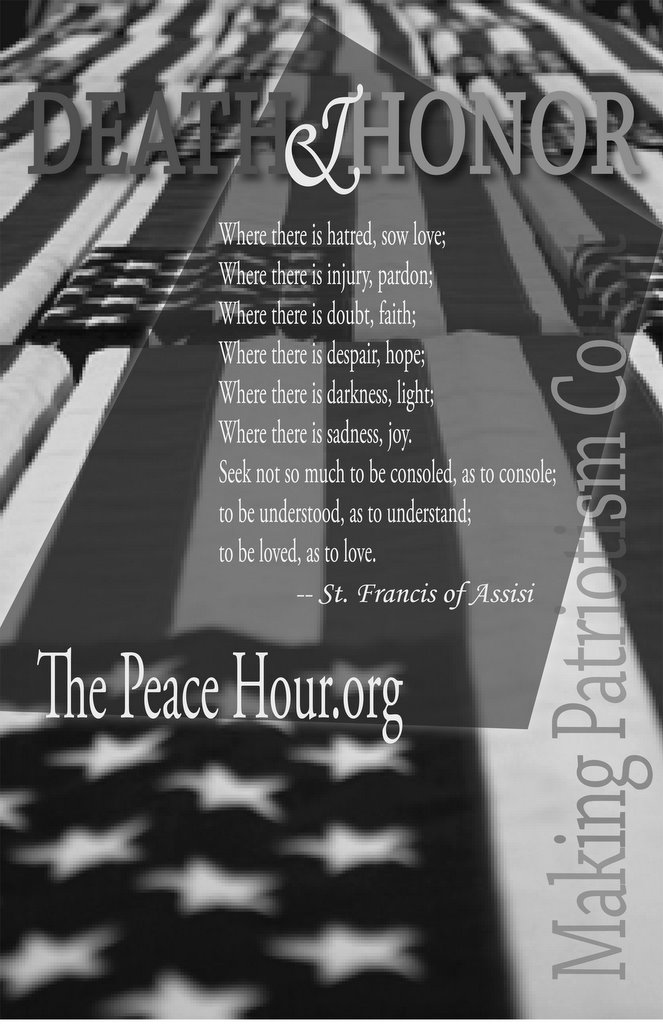
"Where there is hatred, sow love ..."

The stage was devoid of people. Chairs and a podium were all that identified that a program was to start. How soon? No one was quite sure. I sat and watched the empty chairs, waiting on the program to begin and waiting on my reason for being in this place.

These days I'm not standing on ceremony. I'm not trying to be politically correct, overly polite or especially not, the gentle giant! Then I saw him. My reason. The beginning of the story that would culminate the next evening at Sage at Woodway in Houston. But, for now, I'd like to call your attention to this man. He's placing pictures in front of the podium. Two, in fact. The first is a picture of a soldier. Solemn. Dry. The second picture is of a young man with dancing eyes and a slight, but irresistable smile. It's a casual moment. He's wearing a striped shirt. He's loving the moment and he is loved at that moment. The man placing the pictures, stops and gently kisses the casual picture. A tear slowly rolls down his cheek. I'm here for him, I think. I look around. No one else has noticed.

I'm uncomfortable because more and more I'm paying attention. And you can't sit on your hands when witnessing such events as this one. I know without asking that this is the father of the young man--the soldier, yes, but the father of the son with the dancing eyes and charming smile. As he walks away, I come forward and ask him if I might hug him and share a moment in his grief as well as his love for his son.

This has made me consider DEATH and HONOR. We hear these words batted around ... like dying for noble causes: HONOR? I think not. These days the words are used simultaneously. Death AND Honor as in a soldier's death can an honorable one. I would agree with that in theory. Dying to protect a worthy cause. That's an honorable death. That is Death with Honor. Similar in nature ... the "and" and "with" being somewhat synonomous with a slight deviation. This in turn leads to the defining of noble causes. Death and Honor come about only with nobel intentions. Death with Honor are for noble causes. And this is the rub. The death and honor of these young men and women are without question. Their intentions were noble, protecting hearth and home. Their death with honor is lacking acceptance because there was and is no noble cause to justify their deaths!

How do we adjust?
"How can we find a way to honor our dead? The wars of the 21st century have brought tremendous suffering to the world. How do we make our children's deaths count for something?"
I understand pain. There's a Biblical scripture that talks about a time when children won't die before their parents. It talks about an order to the nature of things. We have children, grow older and pass on. Our children bury us with a heart that knows completion. He lived a full life. She lived life her way. None of this happens when our children die before us. I still think of my granddaughter and the short life she had. Yet, whether she was here for a day (in fact it was seven) or seventy years, I was supposed to go first. Period! I also know how my grandmother felt. When her sons died, one at the tender age of 2 and the other at 52, she lost a little more of herself. In later years, I would hear her speak of my Uncle as if she just talked to him although he had been dead a few years.

I've also listened to the parents of those children--yes, children? My children are 26, 27 and 32. They are grown, but I would suffer greatly if one of them were lost to me in death. I know just how painful that can be because my precious Mellilah left before her time. And knowing just that much gives me a small inkling of having someone die who didn't have to die. And isn't that the real issue here? Did these sons and daughters have to die? The answer, they will tell you, is a simple, but resounding "NO!" One would be too many, but the numbers are in the thousands now and before someone else tells me about how many died in WWII or in Vietnam, let me just say this --- we're older and should be wiser. War is not the answer. These deaths did not have to be.

So, there is no genuine comfort in the ceremonies that lay them to rest. For many parents, the souls of these sons and daughters cannot rest because they died unjustly. It wasn't their time and no amount of "honor" or "noble causes" talk can make it so.

So, I listened to the mothers and father that night. I saw the grief in their eyes and I felt the pain in their hearts. But, I also saw resolve. They are ready to wage peace in the names of these children, gone too soon and for no apparent good reason. In order that they bring honor to the lives of their children, they must wage a battle to protect other children. And when they end this war---and mind you, I believe with everything that is in me that they will see that it happens---when this war ends, then their children's deaths will not have been in vain.
"We must make the commitment to JUSTICE and HEALING! And we must do it through non-violent action. True patriotism requires this path of redemption for us all. We must become the instrument of peace."
P.K. McCary

Sunday, February 05, 2006

When We All Get Together ...

What a day of rejoicing that will be
When we all see the peace come
We'll sing and shout the victory!
---readapted from a Negro Spiritual

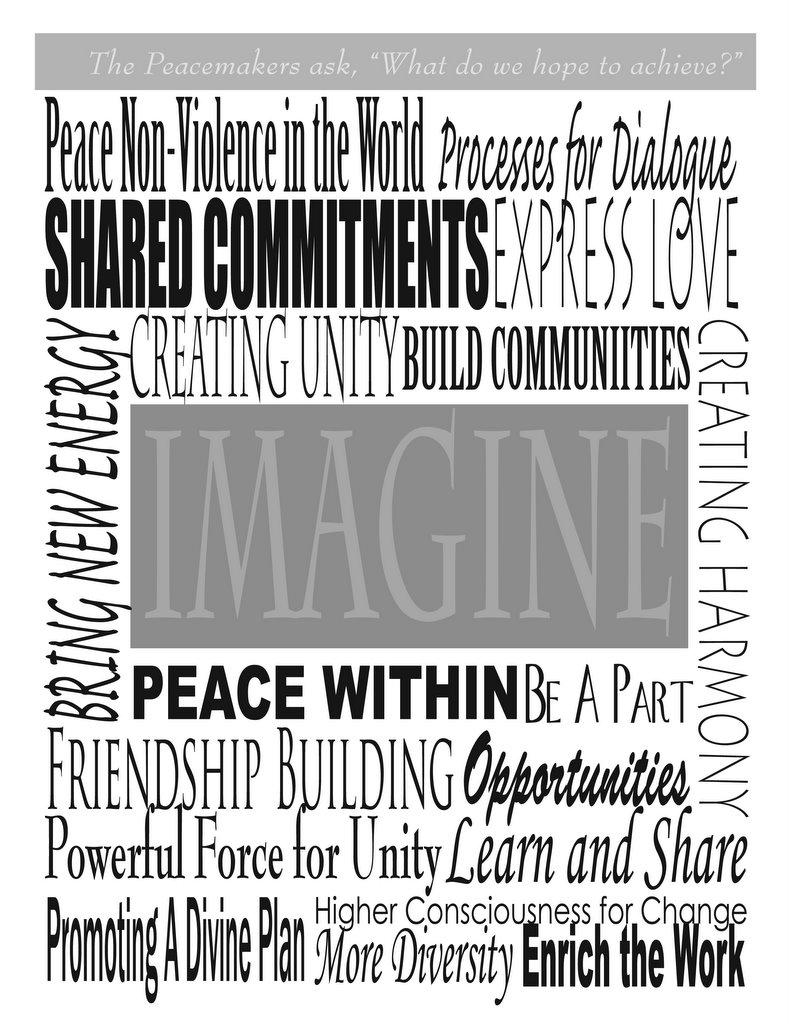
The Peacemakers ask, "What do we hope to achieve?"

On Saturday, February 4, 2006, peace ambassadors from several organizations in the Houston area came together for a day of renewal, collaboration and fellowship. The event was hosted by the Unity Peacemakers (at Unity Church). At the beginning of the session led by Department of Peace-Houston representative, Kathy Kidd, the question was asked of the participants, "What do you hope to achieve?" While the question was specifically targeted to the present event, the answer became an idea that has been permeating the peace movement for a while: IMAGINE ...

...that day when we can see our words in action! What a day of rejoicing that will be. I see it often, but not often enough. Perhaps I see it more clearly than some because I'm intentional in my seeking--intentional in my pursuit. Actions always speak louder than words, but the words set forth in this poster galvanized a thought. We have to keep putting it out there--the words, that is. We have to keep saying it and then acting on these powerful sentiments of what the world will look like when we open our hearts and minds to the possibilities.

IMAGINE! The world awaits our decisions. P.K.

Thursday, January 19, 2006

Building Bridges: Peace by Peace

If God is a god who chooses sides, pits one child against another, then there is no God. But, if, as I suppose, as I try and live my life, God is a god who has no need to pit his children one against another and who offers the same amount of love to either, that is the God I serve.
— P.K. McCary

Conversations on interfaith relations can often take a strange and tension-filled turn. Even one faith, one group of people, can be at odds with one another if one or more individuals branch out to commune with other faiths. People get upset with one another not only because of the choices they make or are making, but because they are not agreeing. One of the questions raised in interfaith communities is whether to allow groups or individuals that espouse fundamentalist beliefs into the (or that particular) interfaith arena. They say things like, They’re not ready. You can’t change ‘em. They do more harm than good.

I’m not sure I like the word—fundamentalist—to describe narrowly interpreted adherence to a faith. I understand intellectually that we’re speaking of narrowly interpreted traditions that create an attitude of supremacy. I get that, but fundamentally, I’m Christian. Because I believe in the virgin birth and in salvation through Jesus Christ, I’m sometimes grouped with those narrow-minded groups headed by leaders such as Pat Robertson or Jerry Falwell. While I don’t proselytize my faith to others, I am hopefully living it. And perhaps that is where the comparison should end. I should just get over it. But, what can I say? I’m sensitive! Oddly enough, many of my friends of other different faith traditions honor my commitment to my faith as I honor theirs. So, where is the tension coming from? Where is the discord in our interfaith work?

I believe that most of us have experiences that obscure our objectivity when it comes to interfaith work. Perhaps we’ve seen the damage that comes from the bigoted and prejudicial thinking of some individuals of their faith tradition. We know the kind of talk that decrees that we have the answer or that God speaks to us alone. For instance, I find it difficult sometimes to talk with my fellow Christian brothers and sisters about my work, but I never give up trying. I tell them that it is important to be committed to your faith, to practice your faith traditions and doctrines. I also tell them that the commitment to one’s faith does not negate another’s commitment to theirs or makes one faith superior to the other. There is no conflict for me in that thinking, but I see the confused look on some faces and fortunately, I understand. I’ve been there. I’m not trying to change their minds about the faith. I’m trying to encourage them to broaden their faith with a respect for other traditions. But, there are those who would believe that we shouldn’t invite the dialogue with those who have a narrow view of this world and the many religions and spiritual expressions if they are not ready to come around. NOW!

We’re up against a mountain of human stubbornness and, of course, fear. Interfaith work is difficult. And rewarding. It is badly represented by some and an awesome experience with others. It seems all we do is talk. We don’t talk enough. We’re working together on some incredible projects. People have been nourished, nurtured and cared for in spectacular circumstances. Interfaith communities around the globe have met challenges. So, should we limit who participates by some criteria? Then one has to ask by what criteria? ‘Who sets the standards?’ This is not a rhetorical question. I’m genuinely asking here. Is there a time when you refuse someone entry into the ‘club’ of the growing interfaith community? Are there some people who just cannot be allowed in? When is it ok to be exclusive? What does being inclusive entail? Who is right about the direction we take in interfaith dialogue? And who gets to decide? What is wrong withthe questions we ask? Questions like: Where should we go? How do we get there? Who gets to answer them? Zora Neale Hurston said once, “There are years that ask questions and years that answer.”

This is the half-way mark of the Decade of Non-Violence. We are definitely in the years of the questions. However, we will have the answers to our questions soon enough and we may not like those answers. If we are asking who can belong to the club, who can participate in the building of this better word, the answer will be in what we create or worse—what we fail to create. I want to build a better world. And I’m tired of looking under rocks and beating the bushes for the snakes. True, I don’t want to be bitten. But, I’d rather die knowing that I didn’t let the threat of snakes deter me from the work that needs to be done? I also know something else. There is another Me waiting in the wings to continue where I left off. I’m finding that I am part of a growing circle of interfaith workers who love this planet. Tenacious. Yes, stubborn, but loving. AND We’re not giving up.

My enemy and I came nigh.
He drew a circle that shut me out.
Heretic, rebel and thing to flout.
But love and I had the wit to win.
We drew a circle that took him in.

Edward Markum emphasizes the need to create a world that includes all. But, I believe some of us want to include all ONLY if and when they change to our way of thinking. In reciting this poem to others, I’ve come to realize that the first line of the poem is often not recited. The first line is telling—‘My enemy and I came nigh’—and reminds me that at this stage of our planet’s metamorphosis, we are currently made up of friends and foes. But, as Pogo once quipped, “We have met the enemy and he is us.” So, I guess we are our own worst enemy. Perhaps we’re standing so close to the enemy (‘us’), that we fail to grasp that it more of the reason why we aren’t building this world we say we want. We’re getting in our own way of building these bridges and making that difference.

There’s a story I love about two brothers who were feuding. A river ran through their property. If that wasn’t enough to separate them, the brothers wanted a clearer line of demarcation. They each decided to build a fence. Since it was such a large task, they both had trouble getting good help, but one brother found a man that not only was willing to work for him, but to start right away. Later, when the brother came to inspect the work, he was livid to find that his precious lumber had been used, not for fences, but to build a bridge. But, just when he was going to give the carpenter a ‘what for,’ he sees his brother running across that bridge, tears streaming down his face. Before he knows it, his brother throws himself into his brother’s arms, tearfully exclaiming, “You are the better brother. You were the first to mend the rift between us. How can I ever measure up?”

Indeed! How can we measure up? By emulating those who are willing to build bridges instead of guarded fences. I believe that we are the carpenters for this better world. What that means is that the feuding, fighting, warring factions will probably continue UNTIL someone builds a bridge that one of them will cross. OK, I can hear the rumblings now. But, some will tear down that bridge. Some will shoot the first person that crosses that bridge. The bridge won’t even get finished! But, I’m hear to tell you that while some of that may happen, other miraculous things will happen, too. We just have to change the percentages. Keep building bridges.

Where are the stories about the real models of peace. I love these stories. I love to tell the stories. Every natural disaster of the year 2005 has been witness to some wonderful interfaith work. Disasters in Louisiana, Sri Lanka, Somalia—to name a few—have shown us what people from different faiths can do. When it is time to help a brother or sister from the depths of such disasters, no one stops to ask—are you a Christian? A Muslim? (OK, maybe some groups asked, but that has not been my experience concerning Hurricane Katrina.) Why can’t we see that we have the capacity to work together and build a better world no matter the faith tradition?

I’m tired, but not so tired that I’ll give up building bridges that sometimes take more time than I’ve been given on this earth to build. But, I know this. There are a lot more bridge builders than we know. We just gotta get to know one another. And there are bridges being built. How do I know? I’ve crossed them. And, it may not look like, feel like, be like, what you envision, but I believe that it will be better!

It has been said that there are some of us who have to see it to believe it. To those I say, ‘You ain’t seen nothing yet!’ And then there are those who believe it so that they might see it. They already believe that ‘We ain’t seen nothing yet!’ Just wait. It’s coming—the bridges, that is. Whole lots of ‘em. Mighty, well-built bridges. You might be surprised who you see coming your way.

I’ll teach my children that bridge building
Will help them to see the world
Across a bridge to foreign places
The world will be strange no more

I’ll teach my children to teach their children
That building bridges is grand
Because the person on the other side
Can often become a friend

I’ll reach my children’s children’s children
Who will no longer fear the others
They’ll see the handiwork of bridges we’ve built
A world united—finally—bridges to one another

Friday, December 09, 2005

The Proverbial Brick Wall ...

The peace movement. What is it? What is moving? Where are we moving to?

I ask these questions in earnest as it seems I hit my head against one proverbial wall or another. The focus gets skewed by all the different directions that are being taken in the quest to create a movement that includes all. And then I realized I was missing some salient points about peacemaking and the MOVEMENT.

One thing is clear. We get disappointed and discouraged. The reason most of us get discouraged and disappointed is that things are not going our way! Simple. We aren't getting what we want out of the movement and we don't see the way clear. But, that's what the movement is about. The movement is the doing. The movement is the crashes. The movement is the disappointments. The movement is the baby steps of creating and the movement is the successes as well as the failures. But the movement is that ... MOVING. We are working towards creating and re-creating our world and while it seems that we have these setbacks (the capture of Christian peacemakers: Tom Fox, Norman Kember, James Loney, and Harmeet Singh Sooden in Iraq; the murder of Taize leader, Brother Roger), we are making progress. I live in that hope.

The questions we must ask of ourselves are:

1. What is my commitment?
2. Where am I willing to go?
3. What am I willing to do?
4. What am I willing to sacrifice?
5. What are my intentions?

The other questions depend on where you are in the movement, but can be key in ascertaining your own direction and the merit of the work that you do. Last week, the Department of Peace-Houston group met to 'exercise' the movement. We met at a little peace coffee house for about two hours, enjoying fellowship and a meal. Some of the questions included the simple ones: What was the most fun you've had this past year? What is your highest dream for yourself?

But the other questions communicated where we were here in Houston. Those questions included:

Discuss the nature of fear. How did fear come up for you as it related to Hurricanes Katrina and Rita?
How do you handle disagreements?
How do you communicate to people you disagree with?
What does it mean to be a peacemaker and what does it mean to the world around you?
What do you expect from yourself?
When we are a world at peace, what will that look like?
What is the next step you want to take in creating peace in your life? In the world?
What are the changes you will make to be the change you wish to see in the world?

Hearing the stories that night was so important. It made me realize that we aren't communicating enough in settings that allow us to be vunerable AND safe. We must create these sacred and safe spaces and we must be so inclusive in our design. The design must be created out of desire to build bridges of hope instead of walls of despair. That is one gift. The other gifts include the sharing of our 'faith,' the giving of our 'grace and compassion,' and the depth of our 'love.'

So, again ... ponder the questions. BUT ... seek out the answers.

Being the peace I wish to see ... P.K.